
Solar panels are getting smarter, but the grass underneath them remains a stubbornly manual headache. Vegetation management is a recurring, expensive operational cost across a solar project’s entire lifecycle. While robotic mowing is emerging as a solution in the US and Europe, a critical truth is often overlooked: a solar farm robot is not just a standard mower with autonomous driving bolted on.
Different companies are solving different problems, giving rise to three distinct approaches in the market:
1. Full Autonomy: Reducing Human Intervention
- The Goal: Make the machine work with minimal human oversight.
- Key Players: Renu Robotics.
- The Logic: Large-scale solar farms (hundreds or thousands of acres) require massive routine labor for traditional mowing, fueling, and relocations. Autonomous navigation, auto-charging, and fleet management drastically cut labor.
- The Catch: Real solar farms aren’t pristine test tracks. Mud, rocks, dense weeds, and uneven ground can easily disrupt autonomous systems. Navigation is only half the battle; reliable field performance is what truly matters.
2. Robotics-as-a-Service (RaaS): Selling the Result, Not the Machine
- The Goal: Shift from hardware sales to outcome-based economics.
- Key Players: Swap Robotics.
- The Logic: Operators don’t care about internal motor specs; they want predictable vegetation costs. Under RaaS, robots become part of the site’s core infrastructure.
- The Catch: Competition shifts from equipment pricing to total O&M economics (cost per acre, maintenance frequency, and seasonal consistency), making it ideal for large portfolios looking to standardize multi-site management.
3. Challenging-Terrain Adaptability: Conquering Non-Ideal Landscapes
The Goal: Prioritize rugged reliability over pure automation on tough terrain.
Key Players: BotusMov.
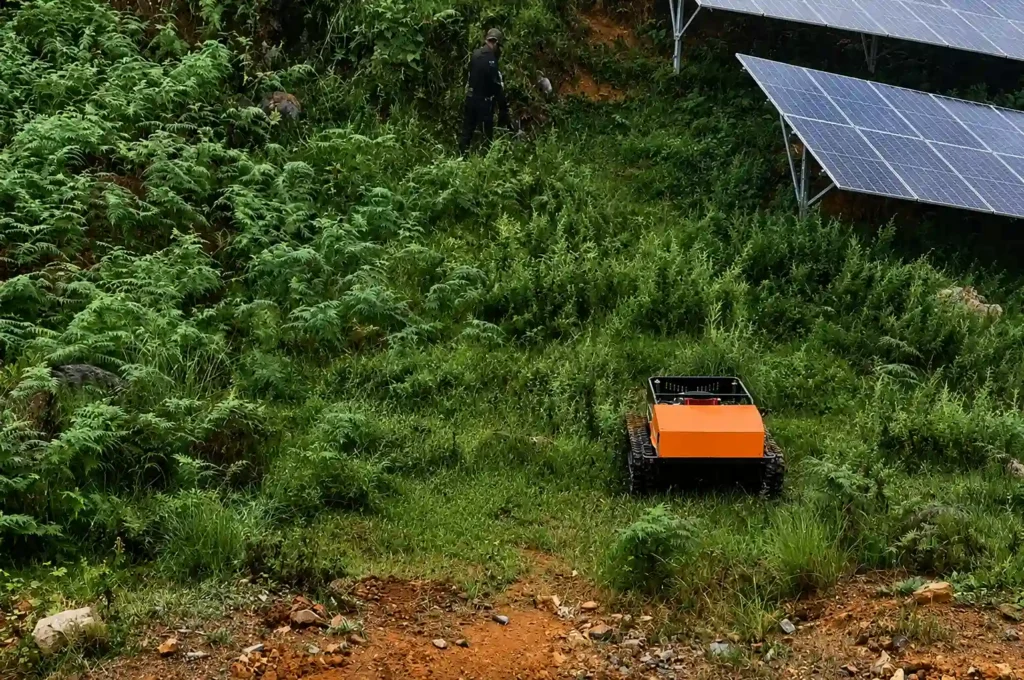
The Logic: Solar farms are built on available land—often slopes, uneven surfaces, and loose soil—not flat testing fields. The primary question shifts from “Can it run without a human?” to “Can it survive these brutal conditions?”
The Catch: For sloped or harsh sites, rugged traction, stability, and cutting performance trump high automation. A heavily automated robot that struggles on a slope is useless compared to a tough, reliable machine [learn more about our slope mowing solutions].
The Bottom Line: Which Approach Wins?
These three approaches aren’t mutual competitors; they address different layers of the same problem:
- Full Autonomy asks: Who operates the machine?
- RaaS asks: Who manages the equipment?
- Terrain Adaptability asks: Can the machine survive the environment?
The future market won’t have a single universal winner. Flat, standardized sites will favor full automation; massive portfolios will lean into RaaS; and complex, sloped terrain will prioritize rugged machinery like BotusMov’s solutions. Ultimately, the smartest robot isn’t the one that looks most impressive in a controlled demo—it’s the one that keeps working when the real world stops being perfect.