
Solar farms are becoming larger and more sophisticated, but managing the vegetation beneath and around solar panels remains a recurring operational challenge.
Grass, weeds, and unwanted vegetation need to be controlled throughout a solar project’s operating life. Traditional mowing methods can involve significant labor, equipment, transportation, and safety considerations, particularly across large sites or difficult terrain.
As a result, robotics is becoming an increasingly important part of solar farm vegetation management in the US and Europe.
However, not all solar farm mowing robots are designed to solve the same problem. Some focus on reducing manual intervention through autonomous operation. Others shift the business model from equipment ownership to outsourced robotic services. A third approach prioritizes machine capability and reliability in challenging environments.
These developments can be understood through three key approaches shaping the market.
1. Autonomous Operations: Reducing Manual Intervention
The goal: Automate repetitive mowing tasks and reduce the need for continuous manual control.
Autonomous mowing is one of the most visible developments in solar farm vegetation management.
Instead of relying on an operator to control every movement, autonomous systems use positioning technologies, sensors, navigation software, and predefined routes to perform mowing tasks with less direct intervention.
Typical technologies include:
- GPS and RTK positioning
- Autonomous route planning
- Obstacle detection and avoidance
- Geofencing and working-area management
- Automatic charging or battery management
- Remote monitoring and fleet management
These technologies can help operators manage repetitive mowing tasks more consistently, particularly across large solar facilities with relatively standardized layouts.
Examples from the Market
Renu Robotics — Autonomous Solar Mowing
US-based Renu Robotics develops autonomous electric mowers for utility-scale solar and energy facilities.
Its Renubot system combines RTK positioning, stored navigation maps, obstacle sensing, autonomous charging, and remote fleet monitoring through its Mission Control platform.
The company reports that more than 100 units are operating in the field across 20 US states.
This approach demonstrates how autonomous mowing can extend beyond individual machine operation to include charging infrastructure, software updates, and centralized fleet management.
Official website: https://renurobotics.com/
Vector Machines — Sensor-Fusion Navigation in Europe
Dutch company Vector Machines provides autonomous mowing systems designed for large outdoor areas, including solar parks.
Its Vector WD2.0 combines GPS, camera vision, and LiDAR to support navigation in environments where relying on satellite positioning alone may be insufficient.
This is particularly relevant to solar farms, where panel structures, restricted spaces, and limited GNSS visibility can complicate autonomous navigation.
The company’s approach highlights an important development in the European market: combining multiple sensing technologies to improve positioning and navigation reliability.
Official website: https://www.vectormachines.nl/en/vector
The Challenge: Real-World Operating Conditions
Autonomous mowing can reduce repetitive manual operation, but it does not eliminate the challenges of outdoor environments.
Solar farms are not uniform landscapes. Ground conditions can change across a site, while rocks, drainage channels, weeds, cables, and panel support structures create obstacles for navigation and machine movement.
Satellite signal availability may also vary beneath panel arrays or around structures.
As a result, autonomous performance depends on more than the navigation system itself. Sensor integration, route planning, machine mobility, obstacle handling, and recovery procedures all influence how reliably a robot can work in the field.
The key takeaway: Autonomous mowing is not simply about removing the operator. It is about building a reliable system that can navigate, operate, and recover under real solar farm conditions.
2. Robotics-as-a-Service: Shifting from Equipment to Service Delivery
The goal: Make robotic vegetation management a service rather than requiring every customer to own and operate the equipment.
Purchasing a robotic mower is not always the most practical option for a solar farm operator.
Equipment ownership comes with additional responsibilities, including maintenance, repairs, operator training, spare parts, transportation, and equipment utilization.
For companies managing multiple solar projects, these responsibilities can create additional operational complexity.
This has encouraged the development of service-led robotic business models, including Robotics-as-a-Service (RaaS).
Under a typical RaaS arrangement, customers pay for an agreed service rather than purchasing and managing the entire robotic system themselves. Depending on the provider and contract, the service may include equipment deployment, operation, maintenance, monitoring, and performance reporting.
Example from the Market
Swap Robotics — Robotic Services for Solar Operations
Swap Robotics, based in Canada, provides robotic solutions for utility-scale solar projects across the US and Canada.
Its business covers several solar project activities, including:
- Robotic vegetation management
- Solar module installation
- Material staging and transportation
The company positions robotic equipment as part of a broader service offering for solar construction and operations.
This is an example of how robotics can be integrated into existing solar project workflows rather than being treated solely as a standalone equipment purchase.
Official website: https://www.swaprobotics.com/
Vitirover — Autonomous Mowing as a Managed Service
French company Vitirover provides a turnkey vegetation management service using autonomous mowing robots.
Its model combines robots, software-based working-area management, and human supervision. The company also emphasizes geofencing and coordinated robot management.
This approach illustrates how equipment automation and service delivery can work together.
Official website: https://vitirover.fr/en/
Why the Service Model Matters
For solar asset owners and O&M providers, the value of a service-based approach is not simply having access to a robot.
It is the ability to outsource some of the operational responsibilities associated with vegetation management.
Before choosing a RaaS provider, operators should evaluate:
- What services are included in the contract?
- Who owns and operates the equipment?
- Who is responsible for maintenance and repairs?
- How are service areas and mowing schedules defined?
- How is pricing calculated?
- What happens when equipment experiences downtime?
- How is service quality measured?
Pricing structures can vary. Some providers may charge according to service areas or project scope, while others may use scheduled service agreements or customized contracts.
RaaS is not automatically more economical than purchasing equipment. Its value depends on project size, mowing frequency, service availability, and the cost of maintaining an in-house operation.
The key takeaway: RaaS shifts the focus from owning robotic equipment to managing vegetation through an outsourced service. It can be attractive for operators who want to reduce equipment management responsibilities, but contract scope and long-term service costs need careful evaluation.
3. Terrain-Adaptive Robotics: Designed for Challenging Solar Farm Environments
The goal: Prioritize traction, stability, and practical field performance across difficult terrain.
Not every solar farm is built on flat, uniform ground.
Many projects are developed on hillsides, uneven agricultural land, sloping terrain, or sites with loose soil and complex access routes.
In these environments, a mower’s ability to navigate independently is only one part of the equation.
The machine must also maintain traction, remain stable, handle vegetation effectively, and move through restricted spaces without damaging surrounding infrastructure.
This is where terrain-adaptive robotic mowing equipment becomes particularly relevant.
What Makes a Mower Suitable for Challenging Terrain?
Several mechanical and operational factors influence performance.
1. Tracked Mobility
Tracked drive systems provide a larger ground-contact area than many conventional wheeled designs.
This can help distribute machine weight and improve traction on uneven or loose surfaces. Tracked systems can also support controlled movement on challenging slopes when properly designed and operated.
2. Stability and Traction
A low center of gravity, appropriate weight distribution, and a well-designed drive system all contribute to machine stability.
However, rated slope capability should never be considered independently of ground conditions. Soil type, moisture, slope direction, and operating procedures can all affect safe performance.
3. Compact Design
Solar panels and their supporting structures can create restricted working spaces.
A compact, low-profile mower can make it easier to access vegetation beneath panel arrays, provided that the machine’s height, width, and turning requirements match the actual site layout.
4. Remote Operation and Intelligent Control
Remote-controlled mowing allows operators to guide the machine in real time while remaining away from the cutting area or difficult terrain.
More advanced configurations can add positioning assistance, route planning, and autonomous navigation.
The appropriate control system depends on the site layout, terrain, and required level of automation.
BotusMov: Combining Terrain Capability with Intelligent Control
BotusMov focuses on industrial mowing equipment for solar farms, steep slopes, and other demanding outdoor environments.
Its MC700 series uses a tracked chassis designed to provide traction and maneuverability across uneven ground and challenging mowing areas.
The series offers different control configurations to address different operating requirements:
- MC700 AIR: A remote-controlled configuration that allows operators to guide the machine directly through complex or changing working conditions.
- MC700: An autonomous navigation configuration that supports planned mowing routes and more structured mowing tasks.
The MC700 series has a confirmed maximum slope specification of up to 35°. Actual operating suitability depends on ground conditions, slope direction, traction, and the machine configuration.
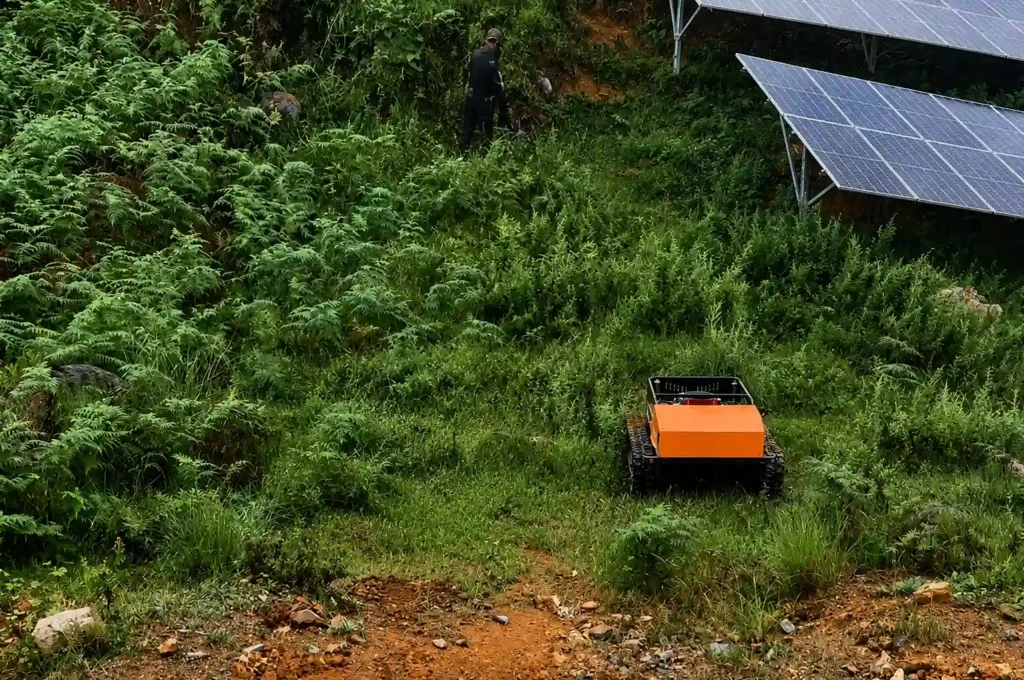
Its low-profile design also supports mowing in restricted-clearance areas beneath solar panel structures, subject to site measurements and access conditions.
Rather than treating automation and terrain capability as competing priorities, this approach recognizes that both machine mobility and control technology matter when selecting equipment for solar farm operations.
Explore BotusMov’s solutions:
The key takeaway: For challenging solar farm environments, a robot needs more than advanced navigation. Traction, stability, cutting capability, ground clearance, and the appropriate control configuration all contribute to reliable field performance.
How Should Solar Farm Operators Choose the Right Approach?
The three approaches discussed above address different aspects of robotic vegetation management. They are not mutually exclusive, and a single provider or system may combine elements of more than one approach.
The right solution depends on the site’s operating conditions and the responsibilities the solar farm operator wants to manage internally.
| Site or business requirement | Approach worth evaluating | Key considerations |
|---|---|---|
| Large, relatively standardized mowing areas | Autonomous operations | Navigation accuracy, route planning, charging, and fleet management |
| Limited in-house equipment and maintenance resources | Robotics-as-a-Service | Contract scope, service availability, pricing, and downtime responsibility |
| Slopes and uneven ground | Terrain-adaptive robotics | Traction, stability, track design, and rated slope capability |
| Restricted space beneath solar panels | Compact robotic mowing equipment | Machine height, width, turning radius, and obstacle clearance |
| Multiple sites across a large portfolio | Fleet or service-based management | Scheduling, equipment utilization, maintenance, and reporting |
| Complex sites requiring operator judgment | Remote-controlled or hybrid-control solutions | Remote operation, visibility, responsiveness, and operator training |
Before investing in a robotic mowing solution, operators should assess several factors:
- Terrain: Is the site flat, sloped, uneven, or a combination of different conditions?
- Vegetation: Does the site mainly contain grass, tall weeds, or dense brush?
- Panel layout: Is there sufficient clearance beneath the panels and between support structures?
- Mowing frequency: How often does vegetation need to be controlled?
- Labor availability: Can the site provide trained operators and maintenance personnel?
- Operating model: Is equipment ownership or outsourced service more suitable?
- Long-term costs: What are the expected costs of equipment, labor, fuel, maintenance, and downtime?
The most effective solution is not necessarily the one with the highest level of automation. It is the one that can consistently meet the site’s vegetation management requirements.
The Future of Solar Farm Vegetation Management
The development of solar farm mowing robots is moving beyond the simple replacement of manual cutting equipment.
Autonomous navigation is making it possible to automate more repetitive tasks. Service-based models are changing how operators access and manage robotic equipment. At the same time, improvements in mechanical design are helping machines work across a wider range of outdoor environments.
Several developments are likely to shape the market:
Greater integration of autonomous technologies
Positioning systems, cameras, LiDAR, and intelligent route planning are creating more capable mowing platforms. Combining these technologies may help improve navigation in complex environments.
More flexible service models
As robotic equipment becomes more established, service providers may offer more integrated vegetation management solutions covering equipment, operation, maintenance, and reporting.
Greater focus on real-world adaptability
Solar farms vary significantly in terrain, vegetation, panel layout, and operating conditions. Equipment that can adapt to these differences will remain important, even as automation advances.
More data-driven O&M operations
Robotic equipment, remote monitoring, and digital management platforms can provide information about operating time, working areas, equipment status, and maintenance requirements. These capabilities may support more systematic vegetation management planning.
Ultimately, the future of solar farm vegetation management will not be defined by one universal type of robot.
Autonomous operation, service-based delivery, and terrain adaptability will continue to develop together. The most suitable solution will depend on how well these capabilities match the actual requirements of each solar project.
Frequently Asked Questions
What are solar farm vegetation management robots?
Solar farm vegetation management robots are machines designed to control grass, weeds, and other unwanted vegetation around photovoltaic installations. They may use remote control, autonomous navigation, or a combination of technologies.
What is the difference between autonomous and remote-controlled mowing robots?
Remote-controlled mowers rely on an operator to guide the machine in real time. Autonomous mowers use positioning systems, sensors, and planned routes to perform mowing tasks with reduced direct intervention. Some equipment platforms offer different configurations for both operating methods.
What is Robotics-as-a-Service (RaaS)?
RaaS is a business model in which customers access robotic equipment and related services through a service agreement rather than purchasing and managing the entire system themselves. Depending on the provider, services may include equipment deployment, operation, maintenance, and monitoring.
Are autonomous mowing robots suitable for sloped solar farms?
Some autonomous mowing systems can operate on sloped terrain, but suitability depends on the machine’s traction, stability, navigation capabilities, and rated operating limits. Site conditions should be assessed before deployment.
How do robotic mowers handle obstacles in solar farms?
Obstacle handling varies by machine. Some systems use cameras, LiDAR, or other sensors to detect obstacles, while remote-controlled machines rely more heavily on operator judgment. Site mapping and operating procedures are also important for avoiding panel structures, cables, and other infrastructure.
How should operators choose a solar farm mowing robot?
Operators should evaluate terrain, vegetation, panel clearance, mowing area, required operating hours, control method, maintenance resources, and total operating costs. The selected machine should be tested or assessed against the actual conditions of the solar site.
Explore Robotic Mowing Solutions for Challenging Solar Farms
Solar farm vegetation management is not a one-size-fits-all task.
Some projects benefit from autonomous mowing and fleet management. Others prefer service-based solutions that reduce equipment ownership responsibilities. For sites with steep slopes, uneven ground, or restricted access beneath solar panels, machine mobility and terrain adaptability are equally important.
BotusMov develops industrial mowing equipment for solar farms and challenging outdoor environments, including tracked remote-controlled and autonomous mowing configurations.
If you are evaluating robotic mowing equipment for your solar project, share your site location, mowing area, terrain, maximum slope, and panel clearance with our team.
Contact BotusMov to explore a suitable mowing solution for your solar farm.