
Agrivoltaic solar farms combine agricultural production with solar power generation on the same land. By allowing crops, livestock, or other agricultural activities to coexist with photovoltaic installations, these systems make it possible to use land for both food production and renewable energy.
However, managing vegetation in an agrivoltaic system is more complicated than maintaining a conventional solar farm. Operators must consider crop growth, ground conditions, panel clearance, equipment access, and the different vegetation requirements across the site. Routine mowing needs to support solar farm operations without interfering with agricultural activities.
Robotic mowing equipment, including remote-controlled mowers, can help address these challenges. With the right equipment and a site-specific maintenance plan, operators can manage unwanted vegetation more efficiently while maintaining suitable conditions for agricultural production.
1. Why Is Vegetation Management Different in Agrivoltaic Solar Farms?
Traditional solar farms generally focus on controlling vegetation around photovoltaic panels, electrical equipment, access roads, and other infrastructure. Agrivoltaic projects have an additional consideration: agricultural production must remain part of the land management strategy.
The layout of an agrivoltaic site can vary considerably. Some systems allow crops to grow between or beneath elevated solar panels, while others combine solar installations with grazing or other agricultural activities.
This creates several vegetation management challenges.
1.1 Balancing Crop Growth and Vegetation Control
Not all plants growing within an agrivoltaic site should be treated as weeds. Some vegetation may be part of the intended agricultural production, while other plants may need to be controlled to prevent excessive growth around solar infrastructure.
A suitable management plan should distinguish between crops, beneficial ground cover, and unwanted vegetation. The objective is not to remove all plant growth, but to maintain vegetation at appropriate levels for the site’s agricultural and operational requirements.
1.2 Maintaining Access Around Solar Infrastructure
Vegetation growing too close to electrical equipment, access routes, panel supports, or other infrastructure can make inspection and maintenance more difficult.
Tall or dense vegetation may also interfere with access to certain areas. In some conditions, excessive plant growth can shade photovoltaic modules, although the actual impact depends on plant height, panel layout, and sunlight conditions.
Regular and targeted vegetation management helps keep designated maintenance areas accessible and reduces the likelihood of vegetation-related operational problems.
1.3 Working Within Limited Spaces
The spacing between solar panel rows, support structures, and agricultural areas determines what type of mowing equipment can operate on site.
A mower that is too wide may struggle to pass through narrow working areas. Equipment that is too heavy may also be unsuitable for certain ground conditions, particularly where soil compaction needs to be minimized.
For this reason, equipment selection should account for the actual site layout rather than relying on general machine specifications alone.
2. Key Vegetation Management Challenges in Agrivoltaic Systems
Before selecting a weeding robot or mowing machine, operators should understand the specific conditions of their site.
Crop Protection
Crop protection is one of the most important considerations in agrivoltaic vegetation management.
Mowing operations should be planned around crop locations, plant height, growth stages, and the available clearance between crops and machinery. Operators should also identify areas where mechanical mowing is unsuitable or where manual maintenance may still be necessary.
Remote-controlled mowing equipment allows operators to manage the cutting process from a distance. However, remote operation does not automatically mean that a machine can recognize or avoid crops. Operators must still define safe working areas and maintain appropriate control during operation.
Uneven Ground and Changing Surface Conditions
Agrivoltaic sites may include slopes, uneven ground, soft soil, and areas affected by irrigation or rainfall.
These conditions can influence traction, maneuverability, and cutting performance. A machine suitable for a firm, level access route may not be appropriate for a sloped or uneven section of the same project.
Tracked mowing equipment may be worth considering where additional traction and ground adaptability are required. The final choice should be based on the machine’s specifications and the site’s actual operating conditions.
Different Vegetation Types
Vegetation varies according to climate, soil conditions, agricultural practices, and seasonal growth.
Some areas may contain short grass, while others may have dense weeds or taller vegetation. A single mowing height or maintenance schedule may not be suitable for every part of the site.
Operators should identify vegetation types and establish different maintenance requirements for agricultural areas, equipment access zones, and designated vegetation control areas.
3. How Weeding Robots Support Agrivoltaic Solar Farm Operations
Robotic mowing equipment can support vegetation management by improving access to difficult areas and reducing the amount of direct manual mowing required.
The benefits depend on the equipment configuration, site layout, and maintenance procedures.
3.1 Remote-Controlled Mowing for More Flexible Operations
Remote-controlled mowers allow operators to control mowing operations without walking directly behind or alongside the cutting equipment.
This can be particularly useful in areas where vegetation is dense, the terrain is uneven, or access is restricted. Operators can adjust machine movement and cutting operations according to the conditions in front of them.
For agrivoltaic projects, this approach can help maintenance teams work in designated vegetation control zones while keeping a clearer distance from the cutting mechanism.
3.2 Access to Challenging Terrain
Not every section of an agrivoltaic site has the same ground conditions. Slopes, uneven surfaces, and narrow passages can make conventional vegetation maintenance more difficult.
Tracked remote-controlled mowers are designed for applications where traction and terrain adaptability are important considerations. Depending on the model and site conditions, they may be suitable for certain sloped or uneven areas.
However, operators should always verify the machine’s rated operating conditions, ground clearance, dimensions, and limitations before using it on a particular slope or surface.
3.3 More Consistent Vegetation Maintenance
A planned mowing schedule helps prevent unwanted vegetation from becoming excessively dense or difficult to control.
Remote-controlled mowing equipment can support repeatable maintenance operations in designated areas. Where the machine supports suitable positioning or path-planning functions, operators may also be able to organize work routes more systematically.
The appropriate schedule should still be determined by local vegetation growth, crop cycles, weather, and site management requirements rather than applying the same mowing frequency throughout the year.
3.4 Reduced Exposure to Difficult Working Conditions
Manual vegetation management can require workers to operate near dense vegetation, uneven ground, and cutting equipment.
Remote operation can reduce the need for operators to remain immediately beside the mower during cutting. This may improve working flexibility in certain challenging areas.
It does not eliminate all operational risks. Operators still need to maintain visibility, follow the equipment manual, keep unauthorized personnel away from the working area, and follow the site’s safety procedures.
4. How to Choose the Right Mowing Robot for an Agrivoltaic Solar Farm
Selecting a suitable mower requires more than comparing engine power or cutting width. The machine must fit the agricultural layout and the operational requirements of the solar installation.
4.1 Check Machine Dimensions and Working Clearance
Start by measuring the available space between panel rows, support structures, crop areas, and other obstacles.
Important measurements include:
- Width of access routes and mowing passages
- Clearance beneath and around solar panel structures
- Distance between crop rows and designated mowing areas
- Turning space at the ends of working routes
- Ground clearance and overall machine dimensions
The mower should be able to move through the intended working areas without interfering with crops or infrastructure.
4.2 Evaluate the Cutting System
Different vegetation conditions require different cutting capabilities.
When comparing equipment, consider:
- Cutting width and its suitability for available passages
- Adjustable cutting height
- Cutting performance in the expected vegetation types
- Blade configuration and replacement requirements
- Ease of cleaning and routine inspection
Cutting height is particularly important in agrivoltaic systems. The required height may differ between access routes, ground-cover areas, and zones near agricultural production.
A suitable mower should provide enough adjustment for the intended maintenance tasks. Operators should not assume that one cutting height is appropriate for the entire site.
4.3 Consider the Drive System and Terrain
The choice between tracked and wheeled equipment should reflect the ground conditions.
Tracked mowers may be suitable for applications requiring additional traction on uneven or sloped terrain. Wheeled machines may be appropriate for relatively firm and accessible areas, depending on their configuration.
Neither system is automatically the best choice for every agrivoltaic project. Operators should compare traction, ground pressure, maneuverability, machine weight, and the manufacturer’s operating recommendations.
4.4 Understand the Control and Navigation Functions
Remote-controlled and autonomous mowing equipment do not necessarily provide the same operating experience.
A remote-controlled mower relies on an operator to control its movements. Some models may also offer positioning assistance or other operating functions.
Autonomous models may support additional navigation or route-planning capabilities, depending on their configuration.
Before purchasing equipment, confirm which functions are included in the specific model. Do not assume that every robotic mower can independently identify crops, avoid obstacles, or operate without supervision.
4.5 Evaluate Maintenance and After-Sales Support
Agrivoltaic projects may require regular vegetation management throughout the growing season. Equipment downtime can interrupt scheduled maintenance.
When evaluating a mower, consider the availability of replacement blades and other components, the accessibility of routine maintenance points, technical support, and warranty coverage.
A clear maintenance plan can help operators keep equipment in suitable working condition and identify wear or damage before it affects mowing performance.
5. Planning an Effective Vegetation Management Schedule
Choosing suitable equipment is only one part of successful agrivoltaic vegetation management. The timing and location of mowing operations are equally important.
Coordinate Mowing With Crop Growth Cycles
Mowing schedules should account for planting, growing, harvesting, and other agricultural activities.
For example, certain areas may require more careful vegetation control during crop establishment, while other zones may be maintained after harvesting. The exact schedule depends on the crop, climate, and agricultural management plan.
Divide the Site Into Management Zones
A large agrivoltaic project does not necessarily need the same vegetation treatment everywhere.
Operators can divide the site into different zones according to their purpose:
- Agricultural production areas: Follow crop-specific management requirements and avoid unnecessary vegetation removal.
- Solar infrastructure zones: Maintain suitable clearance around designated equipment and structures.
- Access routes: Control vegetation to support inspection, transportation, and maintenance.
- Sloped or uneven areas: Select equipment according to terrain conditions and operating limitations.
- Ecological or ground-cover areas: Follow the project’s environmental and vegetation management objectives.
This zoning approach helps prevent unnecessary mowing and makes maintenance planning more systematic.
Inspect Conditions Before Each Operation
Before mowing, operators should check the ground surface, vegetation height, weather, and the presence of workers or agricultural equipment.
They should also identify irrigation lines, exposed cables, support structures, and other potential obstacles.
A site inspection helps determine whether the selected machine and cutting configuration are appropriate for the planned operation.
6. BotusMov Remote-Controlled Mowers for Solar Vegetation Management
BotusMov develops remote-controlled and autonomous mowing equipment for commercial and industrial vegetation management applications, including solar farm maintenance.
For agrivoltaic projects, equipment selection should begin with an assessment of the site’s agricultural layout, available working clearance, vegetation conditions, and terrain.
The MCR1000E remote-controlled mower is a tracked mowing machine designed for demanding vegetation management applications. Its remote-controlled operation allows operators to control mowing activities from a distance, which may be useful when maintaining designated areas with uneven ground or challenging access conditions.
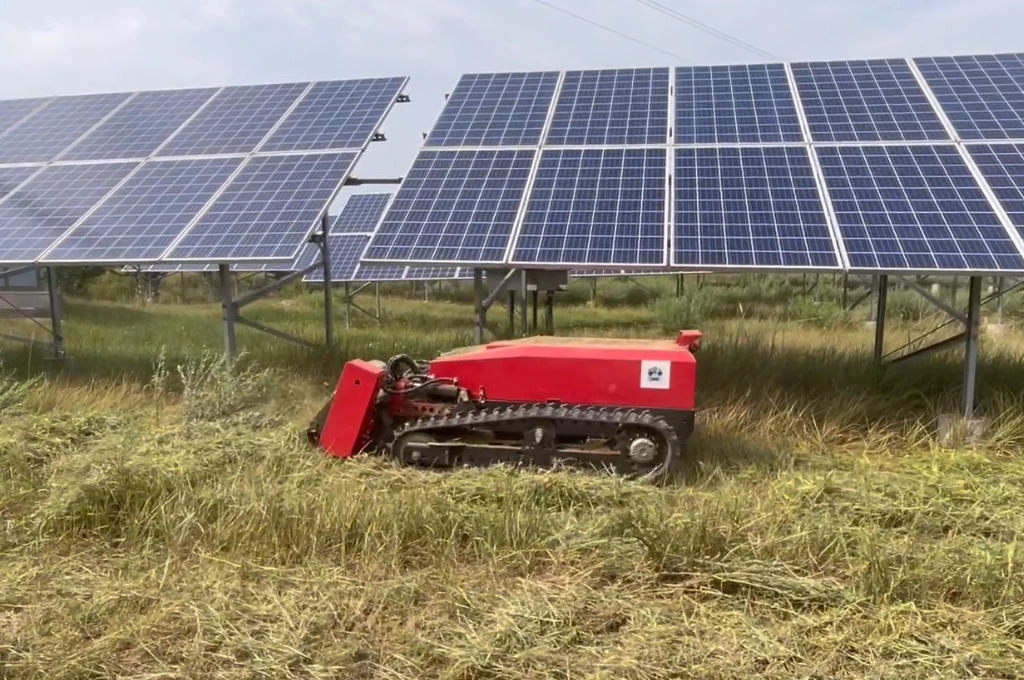
For projects considering more advanced mowing functions, the MC700 offers a different configuration with autonomous navigation capabilities. Buyers should review the specific model’s operating functions and technical specifications before deciding whether it matches their project requirements.
Neither machine should be assumed to automatically distinguish crops from weeds. Agrivoltaic applications require a suitable operating plan, clearly defined mowing zones, and appropriate supervision.
BotusMov also provides a one-year warranty for overseas customers covering the complete machine and its components, subject to the applicable warranty terms.
To determine whether a particular mower is suitable for an agrivoltaic project, operators can provide information such as panel-row spacing, ground conditions, vegetation type, crop layout, and required cutting height.
Visit the BotusMov contact page to discuss your project and request equipment information.
7. Frequently Asked Questions
Can weeding robots be used in agrivoltaic solar farms?
Yes. Robotic mowing equipment can support vegetation management in designated areas of agrivoltaic solar farms. Its suitability depends on machine dimensions, ground conditions, vegetation type, crop layout, and available working clearance.
Will a remote-controlled mower damage crops?
Remote-controlled operation gives the operator direct control over machine movement, but it does not guarantee automatic crop protection. Before mowing, operators should identify crop locations, define working boundaries, and maintain appropriate clearance. Areas where machinery cannot operate safely may require alternative maintenance methods.
Are tracked mowers suitable for agrivoltaic projects?
Tracked mowers may be suitable for projects with uneven ground or certain sloped areas where traction is an important consideration. However, their suitability depends on machine specifications, soil conditions, available space, and the manufacturer’s operating recommendations.
How often should vegetation be mowed in an agrivoltaic solar farm?
There is no universal mowing schedule. Frequency depends on vegetation growth, crop cycles, climate, rainfall, and the management objectives of each zone. Operators should establish a site-specific schedule and adjust it as conditions change.
What should be considered when choosing a mower for an agrivoltaic site?
Key considerations include machine width, cutting height, ground clearance, drive system, terrain adaptability, control functions, maintenance requirements, and compatibility with crop layouts and solar infrastructure.
Can robotic mowing improve solar farm power output?
Vegetation management can help reduce shading risks where tall plants interfere with photovoltaic modules. However, the actual effect on power generation depends on the site’s layout, vegetation conditions, and the extent of shading. Robotic mowing should be considered part of an overall solar farm maintenance strategy rather than a guaranteed method of increasing power output.
Conclusion
Agrivoltaic solar farms require a vegetation management approach that considers both agricultural production and solar power operations. Uncontrolled vegetation can create maintenance challenges, but removing all plant growth is not necessarily the right solution.
Remote-controlled mowing equipment can help operators manage designated vegetation areas, access challenging terrain, and organize maintenance work more flexibly. The key is to select equipment that matches the site’s layout, crop requirements, and ground conditions.
With a well-planned vegetation management strategy and suitable mowing equipment, agrivoltaic operators can better coordinate agricultural activities with the long-term maintenance needs of solar installations.