
Choosing the right lawn mower for hilly terrain requires more than checking its maximum slope rating. Commercial mowing operations must account for slope angle, ground conditions, vegetation density, traction, cutting requirements, and site access. For steep slopes and uneven industrial sites, remote-controlled tracked mowers are often a practical option because they provide strong ground contact and allow operators to control the machine from a distance. Wheeled remote-controlled mowers may be more suitable for flatter, open areas where maneuverability and travel efficiency are priorities.
This guide explains how to evaluate commercial mowing conditions, compare tracked and wheeled equipment, and select a suitable mower for applications such as solar farms, roadside embankments, dam walls, and large industrial sites.
Why Is Mowing on Hilly Terrain Challenging?
Mowing on slopes creates additional demands on equipment, particularly when ground conditions change across the working area. A machine that performs well on firm, level ground may not deliver the same traction, stability, or cutting performance on steep or uneven surfaces.
Several factors affect commercial slope mowing:
- Traction loss: Loose soil, gravel, wet grass, and muddy surfaces can reduce track or tire grip.
- Machine stability: Side slopes, sudden changes in elevation, and uneven weight distribution can increase the risk of sliding or rollover incidents.
- Uneven cutting: Changes in ground height can affect cutting clearance and produce inconsistent results.
- Vegetation resistance: Dense grass, weeds, shrubs, and woody growth place different demands on the cutting system.
- Restricted access: Narrow passages, drainage channels, PV panel structures, and obstacles can limit machine movement.
- Equipment wear: Repeated operation on slopes can increase loads on the drive system, cutting components, and undercarriage.
These conditions make site assessment an important part of equipment selection. A suitable mower should match the actual terrain and vegetation rather than relying on a single performance specification.
What Types of Commercial Mowers Work Best on Hilly Terrain?
Remote-controlled tracked and wheeled mowers are two important options for commercial vegetation management. The appropriate configuration depends on the slope, ground conditions, working area, and required cutting performance.
Tracked Remote-Controlled Mowers
Tracked mowers use crawler tracks instead of conventional wheels. Their larger ground contact area can help distribute machine weight and maintain traction on uneven surfaces.
Key characteristics include:
- Strong traction on slopes and uneven ground.
- Better weight distribution across soft or irregular surfaces.
- Low-profile designs for restricted working environments.
- Remote operation that keeps the operator away from the machine’s immediate working area.
- Suitable configurations for dense vegetation and challenging terrain.
Tracked remote-controlled mowers are commonly considered for solar farms, dam walls, roadside embankments, orchards, and other sites where conventional access is difficult.
However, tracks do not eliminate the risk of slipping or tipping. Actual performance depends on soil conditions, track condition, slope direction, machine configuration, and operating procedures.
Wheeled Remote-Controlled Mowers
Wheeled remote-controlled mowers use tires to provide traction and mobility. Depending on the drive configuration, they can offer efficient movement and maneuverability across relatively firm and open working areas.
Their characteristics include:
- Efficient movement on suitable ground.
- Maneuverability across open working areas.
- A practical option for flatter sites and moderate terrain.
- Different traction characteristics compared with crawler-track systems.
For steep or irregular slopes, buyers should evaluate tire design, drive configuration, ground contact, and the manufacturer’s stated operating limits before choosing a wheeled machine.
Tracked vs. Wheeled Mowers: Which Should You Choose?
The main difference is how each drive system interacts with the ground. Tracked mowers are generally worth considering for steep and uneven terrain, while wheeled mowers can be appropriate for flatter, more accessible sites.
| Selection factor | Tracked mower | Wheeled mower |
|---|---|---|
| Drive system | Crawler tracks | Tires |
| Ground contact | Larger contact area | Tire-based contact |
| Traction on uneven slopes | Generally favorable | Depends on tire and drive configuration |
| Soft or irregular ground | Often suitable | Requires careful evaluation |
| Open, relatively flat areas | Suitable | Often practical |
| Maneuverability | Depends on track and steering design | Depends on wheel configuration |
| Typical applications | Steep slopes, solar farms, dam walls | Open industrial sites and suitable flatter terrain |
There is no single drive system that is best for every project. Buyers should compare the machine’s actual operating specifications with the site’s slope, soil conditions, vegetation, and access requirements.
How to Evaluate Slope Conditions Before Choosing a Mower
A proper site assessment helps determine whether a machine can operate within its specified limits. Do not select equipment based only on the steepest angle advertised in a product description.
1. Measure the Slope Angle
Slope measurements are commonly expressed in degrees or as a percentage grade. These are different measurement systems and should not be used interchangeably.
For reference:
| Slope angle | Approximate grade |
|---|---|
| 10° | 17.6% |
| 15° | 26.8% |
| 20° | 36.4% |
| 25° | 46.6% |
| 30° | 57.7% |
| 35° | 70.0% |
Percentage grade describes the vertical rise relative to horizontal distance. A 35° slope is approximately a 70% grade, not a 35% grade.
Measure the steepest working sections, including transitions, drainage channels, and areas where the ground changes direction. Also distinguish between front-to-back inclination and side-slope operation. A machine’s permitted operating angle may differ depending on the direction of travel.
2. Assess Ground Conditions
The same slope can present very different operating challenges depending on its surface.
Check whether the ground consists of:
- Firm soil or compacted gravel.
- Loose soil or sand.
- Wet grass or muddy ground.
- Rocky or uneven surfaces.
- Soft ground with limited load-bearing capacity.
Ground conditions affect traction, steering, braking, and machine stability. A slope rating should never be treated as a guarantee of safe operation under every surface condition.
3. Evaluate Vegetation Type and Density
Vegetation affects the cutting system and the power required for operation.
Record the dominant vegetation, average height, density, and whether the site contains shrubs or woody growth. Also identify the required cutting height and whether the machine must handle regular grass maintenance or heavier vegetation management.
The cutting deck and blade configuration should match the vegetation. A mower intended for routine grass cutting may not be appropriate for dense brush or woody material.
4. Check Working Area and Site Access
Measure the total working area and identify restricted sections before selecting a machine.
For solar farms, consider clearance beneath PV panels, spacing between rows, mounting structures, cable routes, and access roads. For roadside embankments and dam walls, assess entry points, edge conditions, drainage structures, and available space for equipment transportation.
These details help determine the required machine dimensions, cutting width, turning capability, and operating configuration.
What Features Should You Look for in a Commercial Slope Mower?
A commercial slope mower should be selected according to the demands of the working site. The following specifications deserve particular attention.
Drive System and Traction
The drive system affects how the mower moves across slopes and uneven surfaces. Compare track or tire configuration, drive torque, ground contact, turning capability, and stated gradeability.
For tracked equipment, also check track condition, undercarriage design, and maintenance requirements.
Cutting Width and Height
Cutting width determines how much vegetation the machine can process in one pass. A wider cutting deck may reduce the number of passes across open areas, while a narrower configuration may be easier to position in restricted spaces.
Cutting height should match the vegetation management plan. For solar farms, the required clearance beneath PV panels and the risk of damaging cables or other site infrastructure must also be considered.
Power System
Evaluate engine output, fuel capacity, battery configuration, and the power demands of the cutting and drive systems.
Hybrid systems can combine an internal combustion engine with electric drive components. Buyers should review the actual powertrain design, operating duration, and maintenance requirements rather than assuming that all hybrid mowers have the same capabilities.
Remote Control and Operating Functions
Remote control allows an operator to manage mowing tasks without riding on the machine or walking directly behind it.
When comparing systems, check:
- Remote control range under actual site conditions.
- Emergency stop functionality.
- Engine and blade control.
- Travel speed adjustment.
- Braking and parking functions.
- Signal reliability and operator visibility.
If autonomous operation is required, confirm whether the model supports path planning, positioning systems, route management, and the level of operator supervision required.
Remote operation reduces the need for direct operator exposure to certain hazardous areas, but it does not remove the need for site risk assessments and safe operating procedures.
Maintenance and After-Sales Support
Commercial equipment should be supported by accessible replacement parts, maintenance documentation, and technical assistance.
Check the recommended inspection intervals, track or tire replacement requirements, blade maintenance procedures, and availability of service support in the destination country.
BotusMov provides a one-year warranty for overseas customers covering both the complete machine and its components, subject to the applicable warranty terms.
How to Choose the Right Mower for Different Commercial Applications
Different industrial sites have different vegetation management requirements. The following examples provide a starting point for equipment selection.
Solar Farms
Solar farm mowing requires equipment that can work around PV mounting structures, restricted clearances, cables, and changing ground conditions.
A low-profile tracked remote-controlled mower can be a suitable option for vegetation management beneath and around solar panels. The required machine height, cutting height, cutting width, and operating route should be checked against the actual PV layout.
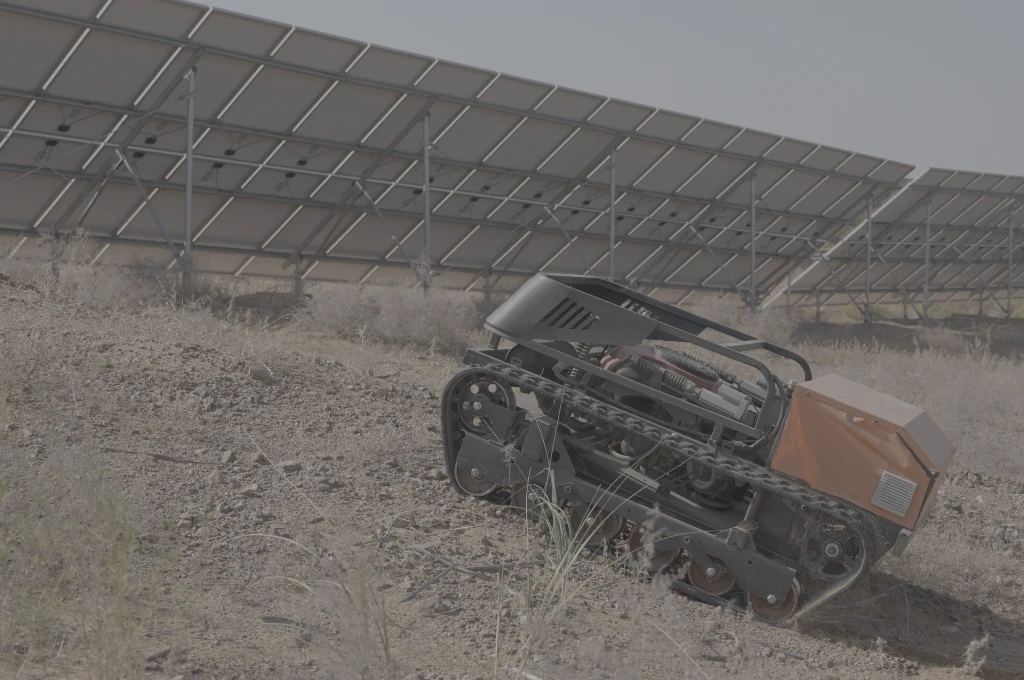
For larger sites with predefined mowing routes, autonomous navigation may also be worth evaluating.
Roadside Embankments
Roadside vegetation management often involves slopes, drainage channels, uneven shoulders, and limited access.
A remote-controlled tracked mower may be appropriate where traction and operator positioning are important considerations. Traffic management, roadside exclusion zones, and access arrangements must be included in the work plan.
Dam Walls and Riverbanks
Dam walls and riverbanks may combine steep gradients with soft soil, wet vegetation, and changing surface conditions.
Before selecting a machine, assess ground bearing capacity, slope direction, drainage, edge hazards, and recovery access. The machine’s approved operating limits must be checked against these conditions.
Orchards and Agricultural Sites
Orchards and agricultural sites may contain uneven soil, narrow access routes, tree roots, and varying vegetation heights.
Consider machine width, turning radius, cutting height, traction, and clearance beneath branches. A tracked configuration may be suitable for uneven ground, while a wheeled configuration may be practical for open areas with firmer surfaces.
What Should You Check Before Purchasing a Commercial Slope Mower?
A clear equipment specification helps suppliers recommend a suitable configuration and reduces the risk of selecting a machine that does not match the working conditions.
Use the following checklist when preparing an equipment inquiry:
| Site information | Details to provide |
|---|---|
| Application | Solar farm, roadside, dam wall, orchard, or industrial site |
| Working area | Total area in m² or hectares |
| Maximum slope | Degrees or percentage grade |
| Slope direction | Uphill, downhill, and side-slope sections |
| Ground conditions | Firm soil, loose soil, gravel, mud, or grass |
| Vegetation | Grass, weeds, shrubs, or dense brush |
| Vegetation height | Average and maximum height |
| Cutting requirements | Required cutting height and frequency |
| Site access | Road access, working width, and restricted areas |
| Operating requirements | Remote control or autonomous navigation |
| Destination | Delivery country and project location |
| Project schedule | Required delivery date and deployment timeline |
Suppliers can use these details to evaluate the required drive system, cutting configuration, machine dimensions, and control functions.
Frequently Asked Questions
What is the best lawn mower for steep slopes?
For commercial mowing on steep or uneven terrain, a tracked remote-controlled mower is often a practical choice. Its crawler-track system provides a larger ground contact area and can offer better traction than some wheeled configurations. However, the right machine depends on slope angle, surface conditions, vegetation, and the manufacturer’s operating specifications.
Are tracked mowers better than wheeled mowers for hilly terrain?
Tracked mowers are generally better suited to steep and uneven ground because their tracks distribute machine weight across a larger contact area. Wheeled mowers can be effective on flatter, firmer, and more open sites. Buyers should compare traction, ground pressure, steering, maintenance requirements, and actual operating conditions before making a decision.
Can a remote-controlled mower operate on a 35-degree slope?
Some commercial remote-controlled mowers have published specifications for operation on slopes up to 35°. However, the maximum stated angle is not a universal operating guarantee. Soil conditions, moisture, vegetation, slope direction, machine configuration, and manufacturer instructions all affect actual operating limits. Always assess the site before deployment.
What is the difference between a 35-degree slope and a 35% grade?
A 35-degree slope is approximately a 70% grade. Degrees measure the angle of the slope, while percentage grade compares vertical rise with horizontal distance. Confusing these two measurements can lead to incorrect equipment selection. Always confirm which measurement system a manufacturer uses when reviewing slope specifications.
Is a tracked mower suitable for solar farm vegetation management?
Yes. Tracked remote-controlled mowers can be suitable for solar farms where the terrain is uneven or sloped. The machine must also fit the available clearance beneath panels and between rows. Cutting height, machine dimensions, cable locations, vegetation density, and access routes should be evaluated before selecting a model.
How do you maintain a commercial remote-controlled slope mower?
Maintenance should follow the manufacturer’s manual and be adjusted according to operating hours and working conditions. Regularly inspect tracks or tires, cutting blades, drive components, fasteners, engine systems, and remote control functions. Remove accumulated vegetation and debris after operation, and address abnormal vibration, damage, or traction changes before returning the machine to service.
What information do I need to choose a commercial slope mower?
Prepare the working area, maximum slope angle, ground conditions, vegetation type and height, required cutting height, site access dimensions, and operating requirements. Include the destination country and expected project schedule when requesting a quotation. This information helps the supplier assess the appropriate machine and configuration.
Find the Right Commercial Slope Mower for Your Project
Selecting a commercial mower for hilly terrain requires a clear understanding of site conditions and operating requirements. Tracked and wheeled remote-controlled mowers offer different advantages, and the right configuration depends on the terrain, vegetation, working area, and required mowing performance.
BotusMov manufactures remote-controlled mowing equipment for solar farms, steep slopes, orchards, and other industrial vegetation management applications. The product range includes tracked and wheeled configurations, with options for remote operation and intelligent navigation.
Request pricing and specifications from BotusMov.
Share your application, working area, maximum slope, vegetation type, required cutting height, site access conditions, destination country, and expected delivery date. Our team can help evaluate your project requirements and recommend a suitable mower configuration.