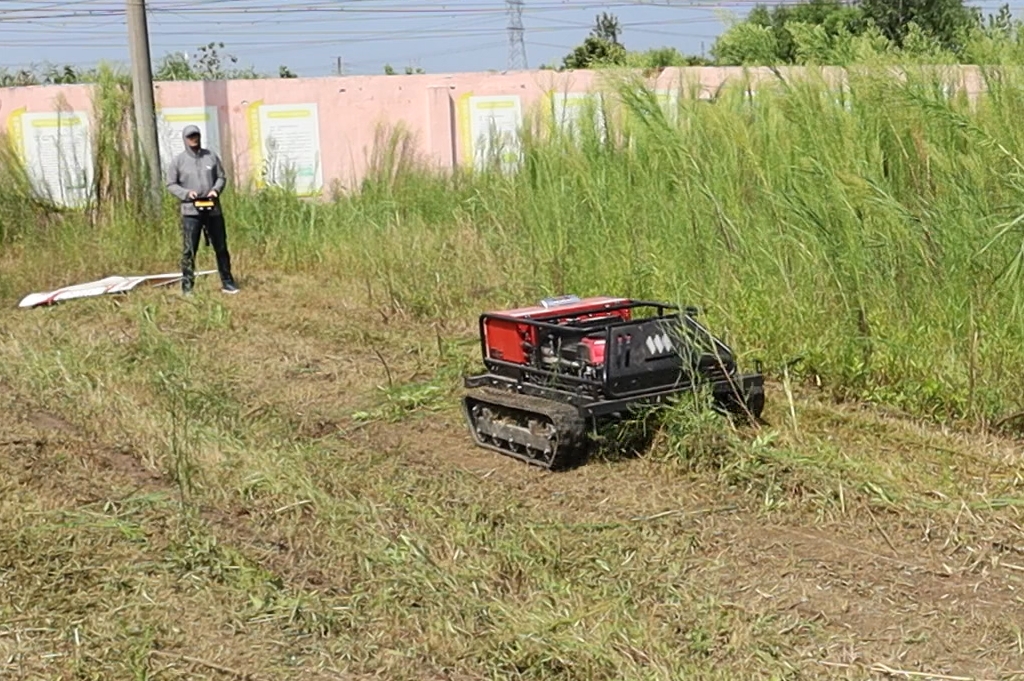
Noise is no longer a minor nuisance — it’s a practical constraint for modern maintenance work. For solar farms, parklands, and residential-edge sites, high-decibel mowing not only disturbs neighbors but also limits work windows and raises safety concerns. This guide explains why quieter mowers matter and how the BotusMov MC700 combines heavy-duty capability with thoughtful acoustic design to become one of the quietest industrial mowers in its class.
Why quiet mowers matter
Gas-powered mowers commonly produce noise levels in the mid-90s dB(A), comparable to motorcycles. That level of sound is disruptive in populated or noise-sensitive locations and, with repeated exposure, can pose hearing risks for workers. Electric and well-engineered hybrid machines usually cut noise by a clear margin — often by 10–15 dB — which translates to a substantial perceived reduction in loudness.
Lower noise levels bring concrete benefits:
- Less disturbance for nearby residents and facilities.
- Ability to operate earlier or later in the day, improving scheduling flexibility.
- Reduced hearing risk for operators and on-site staff.
- Improved environmental compliance in noise-sensitive projects (e.g., community-edge solar farms).
Electric vs. gas: the sound gap
Electric mowers — whether battery-powered walk-behinds, robotic units, or hybrid systems — are typically far quieter than internal-combustion models. A modern electric mower often runs around 75–80 dB(A), similar to the ambient sound of a household appliance, while many gas mowers exceed 95 dB(A). The difference isn’t just in engine type: blade design, RPM, exhaust/noise mitigation, and chassis vibration control all influence the final noise footprint.
BotusMov MC700 — a heavy-duty mower designed with sound in mind
The MC700 is a track-drive, remote-control slope mower engineered for demanding sites — mountain and hilly solar farms, steep embankments, and other uneven terrain. While performance and reliability were primary design goals, BotusMov invested heavily in acoustic engineering so the machine can work longer hours with less disturbance.
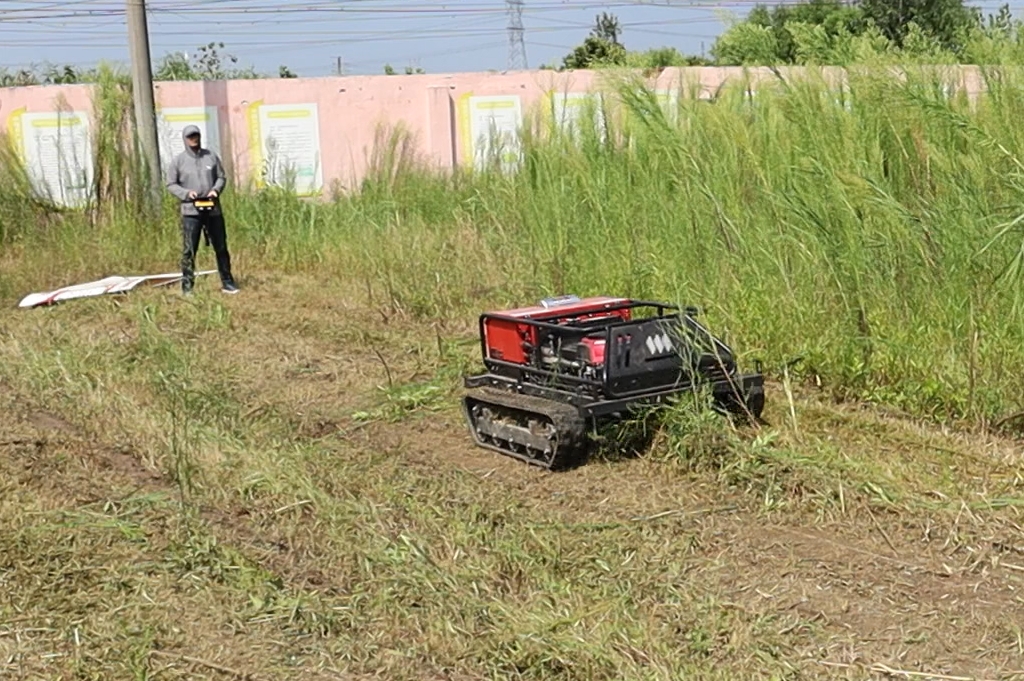
Acoustic and related technical highlights (MC700)
- Operational noise (measured at 7 m): 78 dB(A) — significantly lower than typical petrol mowers of similar power.
- Drive & propulsion: track-drive system with low-resonance gearing and soft-mount motor coupling.
- Cutting deck & blade design: dual-layer floating blade deck and aerodynamic flow guides to reduce blade-induced turbulence noise.
- Vibration management: three-point isolation mounts and elastomeric linkages reduce structure-borne noise and mechanical resonance.
- Control range & safety: remote control up to 200–300 m, allowing operators to work from a safe, quieter perimeter.
- Duty & runtime: designed for long work cycles — reduced high-RPM operation for noise and wear control (typical continuous operation comparable to 4–6 hours depending on load).
These combined measures yield a machine that is not only quieter at typical operating distances, but also mechanically kinder to components — fewer shock events, less wear, and longer maintenance intervals.
How MC700 achieves low noise (engineering summary)
The MC700’s quiet performance comes from a systems approach, not a single fix:
- Engine & enclosure — where applicable, engine compartments use multilayer composite sound-absorbing panels to damp high-frequency emission.
- Blade aerodynamics — CFD-optimized blade shapes and deck flow channels minimize turbulent noise caused by rapidly moving blades.
- Exhaust & combustion tuning — where internal combustion is used for extended duty, exhaust paths are tuned and muffled to reduce peak noise.
- Structural isolation — tracks, deck, and body are connected through vibration-damping mounts to prevent mechanical energy transfer into loudframe resonance.
- Operational strategy — low-RPM high-torque tuning is preferred over high-RPM operation, which cuts audible noise while preserving cutting power.
Practical benefits in the field
Projects that deploy the MC700 report immediate improvements beyond just quieter operation:
- Extended work windows: Teams can schedule early-morning or evening work with lower disturbance risk.
- Reduced complaints: Zero or near-zero noise complaints in community-adjacent projects.
- Fewer protective constraints: Less need for restrictive PPE for hearing in supervised remote operation.
- Operational continuity: Ability to resume work after rain more quickly because remote operation reduces the need for personnel access to slippery slopes.
Use cases: where a quiet, heavy-duty mower matters
- Mountain and hilly solar farms adjacent to rural communities.
- Parklands and green belts where public amenity and peace are priorities.
- Research sites or campuses with noise-sensitive equipment or programs.
- Residential-edge renewable projects where neighbor relations are important.
Real-world outcomes (summary)
Across field deployments, MC700-level acoustic performance has enabled operators to:
- Maintain low complaint levels in sensitive areas.
- Add 1–2 extra workable hours per day in low-noise time windows.
- Increase time-between-service thanks to reduced vibration stress on components.
Conclusion
A truly quiet lawn mower for industrial use must balance performance, durability, and sound control. The MC700 demonstrates that combination: robust slope-capable cutting power paired with purposeful acoustic engineering. For operations that need to minimize disturbance while keeping maintenance efficient and safe, a machine engineered for low noise — one of the quietest in its category — is no longer a luxury, it’s a practical necessity.